Today's lovely walk was a ~3-mile stroll in and around a 550+ acre complex of woodlands and abandoned pastures and farmlands NW of Gainesville, Alachua County, Florida. County development review staff is currently reviewing phases of a 999-unit subdivision to be built over the next decade or so. This is the second largest housing development to come to this area. [Click on images below for a larger view of same.] Protected gopher tortoises abound in open areas of the property. The developer has set aside and fenced in 45 acres of prime tortoise habitat, into which the residents of this site will be relocated during construction. The lucky fellow on the left was stranded in the bottom of a deep (25-30 feet) karst chimney when we arrived, having fallen in during his peregrinations in search of food. He was rescued with the help of a bucket truck and an intrepid helper who rappelled into the hole from the lowered bucket.
 The moss-covered arms of a Florida Live Oak (Quercus virginiana). The brilliant green moss is truly a moss. The gray stringy epiphyte known as Spanish Moss, is not a moss at all. It is, in fact a member of the bromeliad family, of which the pineapple is the fruit of the most recognized species. How does the Spanish Moss get up in the trees? The tiny seeds are furnished with a long tuft of dry hairs like seeds of dandelion or milkweed. They waft long distances in the wind and become snagged on the rough bark of trees, where they germinate. Does the moss hurt the tree? No, although when wet it contributes a good deal of extra weight to the branches, and amplifies the "sail effect" during strong winds. Spanish Moss is not parasitic. It derives all nutrients and water from the air, dirt and debris on the tree bark, and from dew and the rain.
 Corky thorn-covered bark on the lower trunk of a toothache tree, a.k.a "Hercules Club". This tree is in the citrus family with its more recognizable cousins the oranges, lemons, etc. Chew the tart leaves and your mouth and gums go quite uncomfortably numb. The tree prefers open, sunny, dry, sandy upland areas, and is common in old pastures, and along fencelines around old pastures (the seeds "planted" by birds "sitting" on the wires). They're also encountered hanging on unhappily in wooded areas where abandoned pastures and farmlands have been allowed to return to woodland, most commonly populated by the aggressive and weedy laurel oak.
Young Sabal palmetto fronds and branch of a sand live oak. One commonly encounters palmettos beneath oaks in the forested areas of north central Florida. Birds roosting in the oak tree expel the pencil-eraser-sized palmetto seeds onto the ground below, where a few germinate and survive. It is not uncommon to find a veritable thicket of young palmettos beneath oak trees, especially in actively farmed or pastured areas where perches are more or less at a premium, at least locally.
Sabal palmetto. This is the state tree of Florida. You may have seen it's faithful likeness on the verso of the South Carolina quarter dollar. This tree cries "Old Florida" like no other tree. It is my favorite tree, especially in open habitats like this recently abandoned pasture, sandhill communities, and especially though rarely along open shorelines of certain lakes in this area, where the rich morning and afternoon light bathes them in their most vivid and photogenic glory. Some of this particular tree's young offspring are carpeting the ground around it's trunk. In the background, a thicket of young live oaks.
Florida, walking, live oak, sabal palm, palmetto, toothache tree, gopher tortoise, threatened species, hiking, Florida photos
Wednesday, January 23, 2008
Winter Ramble in a Florida Woodland

Thursday, January 10, 2008
Sir Edmund Hillary Dead at 88
Legendary New Zealander Sir Edmund Hillary, the first man to scale Mt. Everest, is dead. His spirit will be missed. May we all encounter that spirit as we walk the hills, dales, and mountains of those places we frequent when we wish to be at one with the world.
Edmund Hillary, Mount Everest, New Zealand, Everest, mountaineering, Hillary
Saturday, December 29, 2007
Another Walk at O'Leno
I hiked the ~4.0 mile Parener's Branch trail at O'Leno State Park with my daughters on December 27. The day was clear and warm, nearly 80 degrees. The miles rolled by really quickly since we were talking and bantering the whole way.
We flushed a trio of whitetail deer not long after we hit the trail. About a mile or so later, far from the developed portion of the park, we found some very large tracks in the sugary sand. One of the tracks had a claw-print pressed into wet soil about the diameter of a pencil. We figured it was likely a black bear track, since the only other large animal that could have produced the tracks was a cougar, and cougars are supposedly extremely scarce in this part of the state. The forested lands bordering the Santa Fe River are fine habitat and an important wild corridor for the movement of large predators between giant tracts of undeveloped wildlands in the Suwannee River watershed and beyond.
The Santa Fe River is as low as I've seen it in the park, in the decade that I've been visiting it. The river sink, where the entire river goes underground, is covered with duckweed and water spangles. During higher water, the river slowly swirls round and round counterclockwise and turtles can be seen hitching rides on pieces of driftwood that spin endlessly in circles around the sink. There was no perceptible movement of the water on this day. All the turtles that were hauled out and sunning themselves were covered in a mat of duckweed.
Santa Fe, River, Florida, O'Leno
Monday, October 1, 2007
Tallahassee-St. Marks State Trail
My wife and I decided to tour the Tallahassee- St. Marks State Trail that runs from Tallahassee FL straight south to St. Marks, at the confluence of the Wakulla and St. Marks rivers. We chose to bicycle the 16 miles rather than tackle it on foot. We decided to explore this nice paved trail upon the strong recommendation of a fellow traveler we met when we hiked and camped at Torreya State Park in September of this year.
The day was lovely and cool, and overcast for the most part. We'd experienced over a week of daily rains, with additional showers in the weekend forecast. The chance of sour weather ensured that there were few people riding the distance. The further away we rode from Tallahassee, the fewer people we encountered.
We parked at the main trailhead, stretched for a few minutes, and then began pedaling. Before we knew it, we'd sailed right past the 5 mile marker. The paved and nearly level surface of the former railroad grade made for easy riding. At about 10 miles we broke out our ponchos and rode through a 5-minute rain shower. That was the only precipitation during the entire glorious ride.
The trail passed through occasional neighborhoods and small commercial areas. For most of its length the trail is bounded on the west by the Apalachicola State Forest, so one has views into piney woods that are being managed by thinning and controlled burns to restore the longleaf pine flatwoods, a nearly extirpated ecosystem (99% gone) that is the home of the endangered red-cockaded woodpecker and other listed or rare species.
The trail ends in downtown St. Marks, a tiny fishing community right on the banks of the river of the same name. We immediately set out to find Posey's World Famous Oyster Bar - only to realize that the establishment is defunct and the building empty. I had to appease my craving for fresh oysters with a fried oyster sandwich at the Riverside Cafe, next door. Posey's was a local destination in its day. Here is how one reviewer described it:"This is [a] real oyster bar and an old landmark and looks like it. "Good smoked mullet and oysters, a real old Florida oyster bar. They also serve other local seafood, but you go here for the mullet and oysters. Take a dollar bill to write your name on and staple to the wall or ceiling, it'll make you feel local. Prices are low."
We dined outside to the views of crab boats chugging by, a crew unloading traps from a boat at the fish house next door, and the timeless saltmarshes extending to the horizon beyond the river. Afterwards we bicycled a mile or so among the marshes to San Marcos de Apalache State Park. We walked the trails around the old fort ruins and toured the museum/visitors' center. The fort sits at the extreme point of land internal to the confluence of the St. Marks and Wakulla Rivers. It was quite interesting to stand on the rocky point with its cedar trees and sawgrass and imagine the parade of indigenous peoples and (since 1528) Europeans that through the centuries have stood at that very spot to fish, and hunt, and watch for marauders, enemies, friends, rescuers, and conquerors. We recommend a visit to this small state park with its very impressive history.
We had just finished strapping the bikes onto the carrier when the rain started. We'd watched towering gunmetal clouds with their skirts of rain advancing eastward across the endless marshlands west of the Wakulla River, and listened as the claps of thunder grew closer and louder. The scene was magnificent and humbling. We were glad to get on down the road after such a lovely day's riding and walking in the area. We're sure to return soon - there are so many natural areas to explore there.
Tallahassee, St. Marks, rail trail, Florida, state parks, Wakulla River, oysters, Apalache, Florida history
Saturday, September 22, 2007
Anastasia Island - St. Augustine FL
We traveled to St. Augustine, FL, our favorite day-trip when we want to mix city-doings with time on the beach. The morning was overcast and drizzly, so we spent a couple of hours visiting our favorite haunts in St. Augustine. We breakfasted and toured the Leitner Museum during the rainiest part of the day. The museum (a former hotel built by Rockefeller's Standard Oil partner Henry Flagler) has some fascinating but rather pedestrian personal luxuries of some of the wealthy northerners of the late Victorian period. Overall, my impression of the museum is that it is more of a mausoleum - and the few recently (more or less) acquired collections (donations) on display are not up to par with what one might expect in such a grandiose building with the history that it has.
A very brief history of the ancient town and the Flagler era is found at this webpage, home of the bed-and-breakfast at the historic Wescott house.
The sun came out, and we lit out for the beach at Anastasia Island State Park. Winds were blowing onto the shorefront at about 30 knots. Red flags warning of dangerous riptides were flapping. We spent a lot of time just lazing in the wind watching the water from beach chairs (which tried to blow away if you didn't sit on them!). After a while I went a-walking - combing the lines of stranded sea-wrack for tropical drift fruits and seeds (seabeans) blown ashore by the weather. I walked north for over a mile picking as I went along, saving just the best one or two examples of each of the types seabeans I encountered.
Seabean.com is a great resource to help you identify and research those fruits and seeds you might have brought home from you last vacation to Florida, and to get in touch with other folks who collect these interesting oceanic oddities.
A brief list of the species I took home, more or less in order of abundance:
- "Indian Almond" - Terminalia catappa
- Spondias mombin
- Manicaria (a palm fruit)
- Saccoglotis "grenade fruit"
- "Sea Heart" - Entada gigas
- Dalbergia - flat coin-shaped legume
- Manchineel - poison ivy tree
- 2 other yet unidentified disseminules
As always, I collected a pile of plastic trash while beachcombing. I concentrate my efforts on a single color to make it more interesting. This day the color was blue, so I returned with an amazing array of blue refuse, including a toothbrush, several butane cigarette lighters, a mismatched pair of child's penguin hair barettes, and a bazillion lids and seals from beverage bottles. The scourge of plastic floating in the oceans and being cast up on the world's beaches is a legacy that will long outlive us and our children and that will bear witness to our species' wasteful and harmful habit of discarding our chemical leavings everywhere. Visit the Greenpeace animation showing the Pacific trash vortex to learn more about the journey of plastic trash in the world's oceans. Scientists estimate the Pacific gyre now has a carpet of plastic trash about the SIZE OF TEXAS.
The 2-or-so mile walk, while beset with wind, was not unpleasant. The beach was anything but crowded, so one could lose one's self in activity and introspection. But my eyes kept burning. I learned later that that stretch of north Florida was under red tide alert. My eyes watered and burned for 2 days.
Florida, beaches, beachcombing, seabeans, drift seeds, Anastasia Island, Flagler, St. Augustine
Monday, September 10, 2007
Hiking Torreya State Park
My wife and I journeyed to Torreya State Park for a weekend camping/hiking trip for my birthday.
We left after a leisurely morning, bound for breakfast on the road and a previously reserved campground. I'm a professional botanist, and during the dozen or so years in Florida had yet to explore this botanically-rich park on the banks of the Apalachicola River. I'll say from the outset that we had a most remarkable and enjoyable weekend. For the weekend we packed a cooler full of frozen water, snacks and food for 2 days, our hiking and camping gear, a small fold-out table, and our old portable color television. I'll mention the TV later.
We stopped for breakfast in Bristol, a small community not far from our destination. We ate at a country-cooking restaurant called" Pouncey's", a name that baffles us still. I immediately thought "cat" upon reading the name, and had no idea that that intuition would play into the tale that follows. We dined on an "adequate" meal of scrambled eggs, corned-beef hash, biscuits and gravy, grits and home fries. The wife went to the restroom while I paid. Suddenly there was a noisy commotion in the kitchen attended by shouting, banging, and the sounds of struggle. Peering in the windows of the swinging waiters' doors into the kitchen I observed a young female cook and an older waitress clash amid a storm of profanity. When the shoving and shouting turned to thrown punches, screaming and hair-pulling, two young busboys leapt from their vigil at an unused table to stare at the ruckus behind the doors. The cashier who had been processing my bill camly turned and said in a wonderful drawl to the boys, "I wouldn't stand there, last time they went at it they were throwin' kitchen stuff and eachother right out those doors".
I watched with a little glee and a lot of concern at the full-blown pouncy cat fight while wondering if I hadn't ought to collect the wife and run for cover. Two other ladies from the kitchen tried to break up the fight to no avail; it took two additional male kitchen staff members to subdue them and stop the fighting. Try as they might, they couldn't stop the profanity. As I finished paying, the older of the two combatants quit on the spot and stormed out in a flurry of profanity. The cause of the battle: a side order of biscuits that wasn't ready. I think the scene was about as redneck a thing as I have ever seen. Of course, my wife missed the whole thing, minus the sounds of the commotion ringing through the walls.
We continued on our way and arrived at Torreya shortly after noon. We checked into our campground and began to explore the area. We immediately realized we'd picked a wonderful site, #17 in the Weeping Ridge camp area. This particular site has a westerly view from the bluffs of the Apalachicola River and is adjacent to an open area with a short trail that leads to an overlook of the river bottoms and the lands beyond. We set up our tent, got situated, then went for our first walk of the weekend. We hiked down roads to the Gregory House, an antebellum mansion situated atop the bluff overlooking the river 260+ feet below. We found a trail leading north from the mansion grounds, and soon found ourselves hiking past civil war cannon emplacements notched into the top of the bluff. The trail wound down the bluffs to the river bottoms, then turned south along the river, eventually leading up the bluff back to the camp. We spotted 2 wild hogs among the towering cypress, winged elm, sycamore, and tupelo trees in the river bottom. One of the large hogs was black and white. It was a great start. We got back to camp, showered, and prepared for dinner and some television watching.
Not just any television. It was Saturday evening, and we were determined to watch British comedies on the local PBS channel out of Tallahassee. We lit several votive candles and set them around the camp area, lit a large citronella candle, and spent a quiet evening alternately watching the sunset and wry comedy on TV. As dusk fell, a tiny bat flew right between our heads as we sat side-by-side laughing at the antics of the British actors. A few more bugs came out as we began to tire from our hike and from sitting in the camp chairs. We simply took the TV and its table into to tent and continued watching from our bed until sleep compelled us to retire. We felt like we'd discovered the ultimate lap of luxury with the sunset, our flickering candles and watching television under the stars.
The next morning we found a much longer and harder trail to occupy us. We hiked from the picnic area near the Gregory house along a trail that took us past the CCC stone bridge, Rock Creek, and through upland areas of the park. The trail traversed deep ravines with thickets of the rare Torreya tree, up and down the ravines and ridges that finger through the park, across broad expanses of sandhill scrub with rocky cliffs and amphitheaters, back down to the river bottoms, and straight back up knife-edge ridges to the shoulders of the bluffs. We drank the rest of our water on that hike, but were rewarded with a diverse array of topography and plant communities that one couldn't imagine could occur in one half-days' hiking. During this second days' hiking we saw a white-tail deer (immediately after my wife mentioned "here" is where I'd expect to see a deer), and a barred owl. This hike was very, very strenuous to we who had become used to walking relatively flat areas over longer distances. The wife's summary during the drive home and remembering afterwards proclaimed that that second hike "spanked our butts". I don't exactly disagree. But I'd return in a heartbeat, straight to that lovely campground #17, and do it all over again.
Below is a list of common names of the 50 or so tree species I identified during the hiking in Torreya St. Park, more or less in the order in which I remembered them as I wrote them down after each hike:
Tulip tree (grand examples)
American beech
2 different hawthorns
Ash
Basswood (linden tree, lime tree)
Water oak
American holly
Carolina silverbell
Hornbeam
Hophornbeam
Red mulberry
Florida sugar maple
Winged Elm (state champion here has lost its crown, and status, alas.)
Sugarberry
Sand pine
Loblolly pine
Slash pine
Bald cypress
Needle palm (you mightn't ever see so many in the wild as here)
Red buckeye
Sycamore
Southern magnolia
Mockernut hickory
Dogwood
Wax myrtle
White oak
Sparkleberry
Southern red oak
Swamp chestnut oak
laurel oak
Southern red cedar
Southern live oak
Redbud
Boxelder maple
Red maple
Persimmon
Yaupon holly
Red bay
Wild cherry
Laurel cherry
Black gum (upland tupelo species)
Torreya
Crab apple
Turkey oak
Bluejack oak
Longleaf pine
Witch hazel
Chickasaw plum
Swamp tupelo
Ashe's magnolia
The Torreyas were among the most memorable trees, and to see thickets of them was magical, since they grow wild nowhere else on earth. I saw the largest sparkleberries I'd every seen; lovely individuals of this arborescent blueberry. I must return again to ferret out the elusive Florida Yew, which also is found in the park.
The 2 park staff members we interacted with during our stay were very obliging and helpful. They helped make it a most wonderful weekend. We returned with a couple of pounds of locally-harvested tupelo honey as a souvenir.
Torreya, Florida parks, state parks, wild hogs, hiking trails, Florida trails, walking trails, Apalachicola River, Confederate army, rare plants, biodiversity, Florida beech, Florida yew
Saturday, September 1, 2007
Evinston-Micanopy Bob Cunningham Memorial Walk
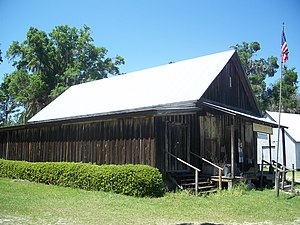
We began our outing with a long chat with Freddy Wood, his wife Miss Sue Wood, and Freddy's brother Ashley (Ash) in the Wood and Swink store where our post-box was located when we lived in that lovely hamlet prior to purchasing our 1935 restored bungalow in the northwestern part of the county. We sat in ancient chairs near the wood stove which supplies heat to the Wood and Swink store during the winter months. We hadn't seen Freddy and Sue since the Evinston-Cross Creek paint-out in February, when we last walked the route. Freddy farms the land behind the store in the photo, above, and Miss Sue is the long-time post-mistress. Freddy's father was postmaster for several decades until his wife took over the job. The store and post office has been in the Wood family since the turn of the century, a store that is listed in the National Register of Historic places. I was pleased to learn that in two or three weeks time okra, peas and tomatoes will be ready and for sale in the store. My wife and I relished eating vegetables that were picked by Freddy that day, when we lived in Evinston before. We really relished knowing that buying and eating Freddy's produce had been a continuous community tradition for many decades before we lived there, among just a handful of families. We'll show up there in 2-3 weekends, cash and carry-bags in hand.
The first four miles of the walk went fast, since we were fresh and walking in the cool of the morning. We took note of bird calls, blooming plants and other natural features along the sandy roads to Micanopy. Upon arriving, we lunched on sandwiches and soup at our usual haunt, the Old Florida Cafe. A cowboy-hatted, cowboy-booted, jeans-wearing man with an enormous gray Brahman steer, a big white goose, and a liver-spotted Australian shepherd-dog offered rides to passersby across a little alley near the center of the road that runs through the short antique store lined main street.
That same managery minus goose, can be seen in this rainy-day video clip recently posted on YouTube by some other happy visitor to Micanopy. We laughed when the cowboy mounted his massive steer and rode around the sunny thoroughfare, white goose and liver-spotted sheep dog tailing behind, the animals maintaining a polite and ordered distance as the great cow with rider stepped out its measured pace along the street.
The return walk back to Evinston was completely different from the initial walk. The sun was fully up in the sky, the road was hot, and the humidity and temperature had risen appreciably. We were forced to shake off the languid feeling of having eaten a delightfully full meal, and had to stretch muscles that thought they were finished exerting for the day. Out came the hats to shade the sun from our brows and eyes. Limbs and feet felt the heat of the day, and the return walk dragged on in comparison to the earlier effort. We were tiring, and feeling the "stretch" part of the walk, and were drinking frequently from bottles of the previously frozen water we'd carried with us.
Despite feeling the burn from resuming the walk in the hotter part of the early afternoon, we were happy. We had water to spare; there were shady breaks at regular intervals; and we anticipated the satisfaction that we would soon complete the last of an 8-mile walk during the high-summer heat in Florida.
Evinston was quiet when we arrived. We simply got in the car and drove away, promising to walk the route again with friends, or without, when the weather cooled a bit. The whole journey, including trekking, lunch, and travel time to and fro, was about 6 hours. We'd do it again in a heart-beat or two.
Florida, Alachua County, Evinston, Micanopy, hiking, walking, trekking, backroads, trails, trail association


